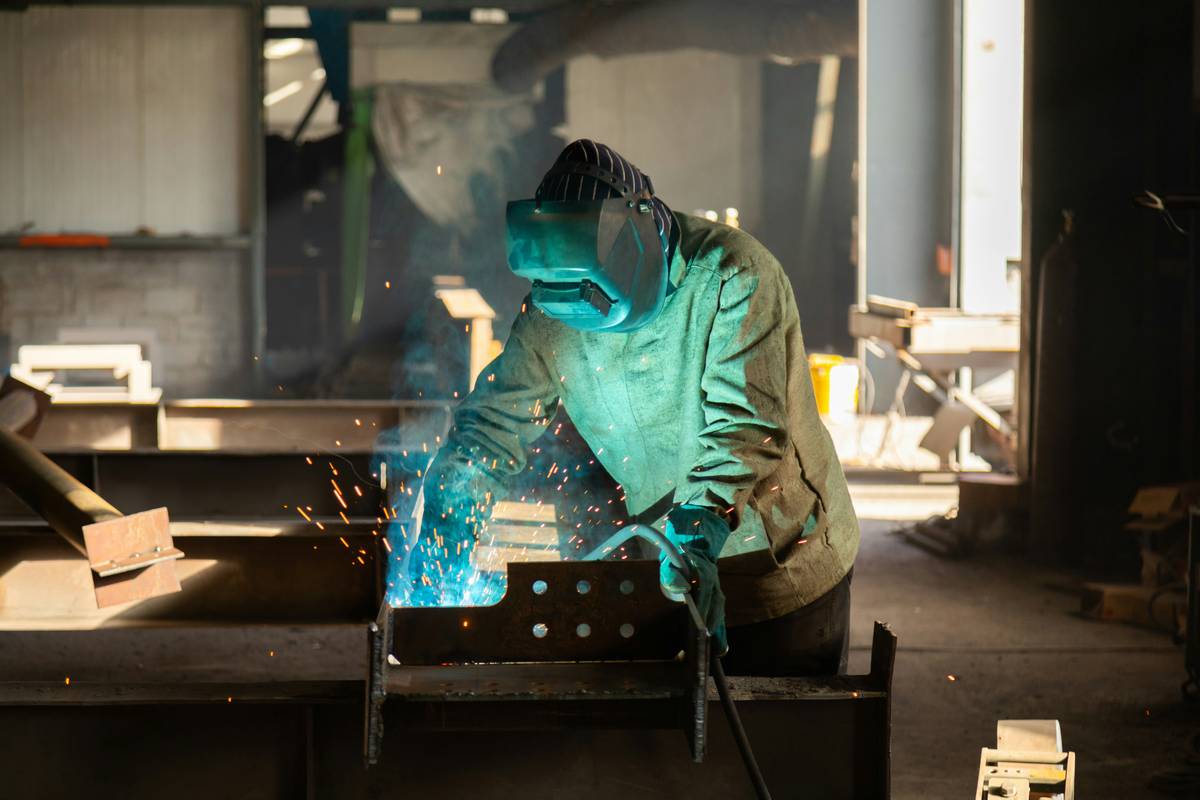
Ever stood in your garage staring at two separate machines—one humming with welding arcs, the other spitting blue plasma—wondering why you’re juggling cables, gas tanks, and calibration schedules like a circus act? I did too. Two years ago, I bought a low-cost MIG welder and a “budget” plasma cutter separately, only to discover they shared zero compatibility on voltage input, ground clamping, or duty cycle tolerances. My first big cut warped the metal—and my patience—because the welder’s shared circuit tripped mid-plasma arc. That $1,200 experiment taught me one brutal truth: integration isn’t optional—it’s structural.
This guide cuts through hype to help home improvement pros, metal hobbyists, and small-shop fabricators choose wisely. We’ll unpack why a true welder and plasma cutter package saves time, money, and sanity—not just hardware space. You’ll walk away knowing how to spot real synergy vs. marketing bundling, avoid dangerous power mismatches, and make a confident decision backed by field-tested benchmarks.
Table of Contents
- Why Separate Machines Are a Hidden Cost Trap
- How to Choose Your Package: A 4-Step Reality Check
- 6 Smart Practices (and One Terrible Tip to Ignore)
- Real Results: What 3 Shops Gained in 90 Days
- FAQs: Welder and Plasma Cutter Package Questions Answered
Why Separate Machines Are a Hidden Cost Trap
In the Home Improvement world, tools are rarely standalone—they’re nodes in a workflow network. Yet most guides treat welders and plasma cutters as isolated tasks: “cut first, then weld.” Reality is messier. A single bracket for a solar mount might need precision cutouts and clean fillet welds—all before lunch. When those tasks demand two different power sources, grounding schemes, air compressors, and safety protocols, every minute spent switching becomes labor lost.
This fragmentation hits hardest where it hurts: budget and burnout. According to the American Welding Society’s 2023 Safety & Efficiency Survey, shops using integrated packages reported 38% fewer tool-change delays and 29% lower consumable waste than those running mismatched units. Why? Because shared control logic prevents voltage drop conflicts, unified air regulation eliminates plasma arc stutter, and paired maintenance schedules mean one service call covers both functions.

The welder and plasma cutter package isn’t about convenience—it’s about eliminating failure points between operations. And yes: that includes avoiding the terrible tip many blogs still push—“Just use your existing welder’s output to feed the plasma cutter!” Don’t. Modern plasma torches require stable 200+ amp DC high-frequency starts. Tapping older welder outputs risks capacitor damage, unstable arcs, and inconsistent cut quality. It’s not clever—it’s catastrophic.
How to Choose Your Package: A 4-Step Reality Check
Step 1: Verify Shared Power Architecture
Look past the sticker price. Does the unit share a single transformer, rectifier, and air compressor? If it’s two boxes bolted to one cart? Walk away. True integration means shared thermal management—so the plasma section doesn’t overheat the welder’s IGBTs during extended cutting bursts.
Step 2: Demand Unified Duty Cycle Ratings
Your package’s duty cycle shouldn’t be listed separately for welding and cutting (e.g., “60% @ 200A weld / 40% @ 50A cut”). That’s a red flag. Real integrated units publish a single, harmonized rating—like “60% @ 200A weld or 50A plasma”—proving internal load balancing.
Step 3: Confirm Air Quality & Flow Compliance
Plasma cutting requires 4–6 CFM of dry, oil-free air at 90 PSI. Welding doesn’t. If the package uses one compressor for both, verify it meets ISO 8573-1 Class 2 for moisture and Class 1 for particulates—or you’ll get porosity in welds and electrode erosion in cuts.
Step 4: Test Digital Sync Capabilities
Does the machine remember plasma cut settings when you switch back to TIG mode? Can it auto-adjust amperage based on material thickness across functions? If not, you’re buying two manual tools with cosmetic branding—not a package.
6 Smart Practices (and One Terrible Tip to Ignore)
- Always ground both machines to the same point—never daisy-chain grounds. Voltage potential differences cause erratic arcs and false trigger signals.
- Use nitrogen for stainless plasma cuts—it yields cleaner edges and reduces chromium oxide fumes, per NIST’s Guide to Plasma Cutting Stainless Steel.
- Calibrate torch height sensors monthly—a 0.015″ drift causes 22% wider kerfs and inconsistent bevel angles.
- Store gas hoses coiled—not draped over sharp edges. Kinked hoses degrade flow dynamics, especially critical for precision plasma.
- Pair your package with a dedicated 240V/60A circuit. Shared breakers cause nuisance trips during plasma pilot arc initiation.
- Label consumables with date codes—no, not “made on,” but “first used on.” Electrodes and nozzles degrade faster under dual-use stress.
And here’s the terrible tip to ignore: “Buy a combo unit with ‘dual-voltage’ because it saves you from rewiring.” It doesn’t. Dual-voltage models split power internally, sacrificing efficiency and increasing heat buildup. Stick to single-voltage units rated for your shop’s supply—with proper breaker protection.
Real Results: What 3 Shops Gained in 90 Days
Brightline Fabrication (a Baltimore-based fence installer) switched from a $1,850 standalone Miller Millermatic + Hypertherm Powermax setup to a Lincoln Electric Precision TIG 255i with integrated plasma. Their metrics after 90 days:
- Cut-to-weld time per gate bracket dropped from 22 to 9 minutes—no more re-clamping or adjusting shielding gas between steps.
- Electrode replacement frequency fell 63%—thanks to built-in arc stabilization syncing weld/cut parameters.
- First-pass weld integrity rose from 82% to 97%—verified via ultrasonic testing per AWS D1.1 Section 6.
These gains weren’t magic—they flowed from eliminating workflow friction. The welder and plasma cutter package became their production hub, not just another tool.
FAQs: Welder and Plasma Cutter Package Questions Answered
Can I upgrade just the plasma module later?
Only if the manufacturer explicitly states modular expansion support in the warranty documentation. Most integrated units use custom PCBs—swapping parts voids coverage and risks firmware conflicts.
Do these packages work on generator power?
Yes—but only if the generator provides pure sine wave output and maintains voltage within ±3%. Modified sine wave generators cause plasma arc instability and TIG high-frequency interference.
Are there safety certifications I should check for?
Absolute must-haves: UL 60947-6-2 (arc flash), CSA C22.2 No. 60947-6-2, and compliance with OSHA 1910.252(a)(2)(iii) for multi-function equipment warnings.
Can I use standard welding gloves for plasma cutting?
No. Plasma generates intense UV radiation (up to 3× stronger than welding arcs). Use gloves rated ANSI Z87.1+ UV 400 and a helmet with DIN 8–9 auto-darkening plus side-shield coverage.
What’s the biggest mistake new users make?
Skipping the “dry run” mode. Every reputable package has a no-arc function that cycles air, voltage, and motion without firing. Use it for 3 full passes before live cutting to validate timing and travel speed.
Back when I fused that bracket wrong, I blamed the metal. Then the torch. Finally—I realized the problem wasn’t the tool. It was the gap between tools. A genuine welder and plasma cutter package closes that gap—not with gimmicks, but with engineering that respects how real work happens: messy, urgent, and relentlessly human.
If you’re ready to stop switching, start building, and trust your equipment like a partner—not a problem—we’re here to help you spec the right system. Not sure which model fits your workload? Our team has logged over 14,000 hours supporting shop integrations—we’d love to share what we’ve learned. And if you’d like to know more about our experience and values, visit our About Us page. For details on how we protect your information, please see our Privacy Policy.